
Rajagopala Chidambaram, a renowned Indian scientist who played a pivotal role in the country's nuclear tests of 1975 and 1998, passed away on Saturday at the age of 88. He was also associated with India's nuclear weapons program and served as chairman of the Atomic Energy Commission and Principal Scientific Advisor to the government.
'He was deeply committed to nurturing young talent and encouraging interdisciplinary collaboration.'
'The very fact that his autobiography is called India Rising is a correct example of his wish for India to be a developed country and do as best as possible by science reaching to the common people.'
M R Srinivasan focused on the peaceful use of nuclear power at a time when the popular view among the 'hawks' was that India should build a nuclear arsenal as a deterrent.

'We were in a heavily nuclearised environment. China had tested for Pakistan in the 1980s and helped their missile programme stay just one step behind us.'

'Rajagopala Chidambaram's smile, simplicity and ability to put younger colleagues at ease always encouraged me to approach him for advice or guidance.'
Although the credit for acquiring the technological skill must be given to India's outstanding nuclear scientists, the decision to go nuclear was a political one that entailed clarity of vision, courage and resolve, points out Rup Narayan Das.

I suggest we build a Vigyan Mandir (Temple of Science) with the ambience of a place of worship, so that it becomes a destination for pilgrims. We should embed on its walls bronze plaques describing each scientist mentioned here along with about a dozen of our ancient mathematicians, recommends Professor Kalyan Singhal, historian of science and technology.
Dr Kakodkar's strategic stubbornness ultimately got India what it wanted though the negotiations with the US went to the wire, notes Shivanand Kanavi.

It's time India re-visited its Western alliances for the attitude and approach that the West reserves for the nation when it comes to security cooperation of the kind that they might not have visualised outside of China, India's bug-bear, asserts N Sathiya Moorthy.

Dr Bhabha and Dr Sarabhai didn't feel guilty for their ambitions; it was for those 'mad scientists' that India is a powerhouse -- both at the atomic level and in the vastness of space, observes Kumar Abishek.
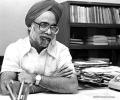
What stood out in his 15-year journey as a member of the political executive at the Centre was his glowing record as India's most successful and effective finance minister. Both as prime minister and finance minister, he understood the importance of gradualism, except when the economy or the polity was in a crisis.

Vajpayee had always felt that India must act with conviction and panache. He decided that, irrespective of the attendant risks, he would undertake what many felt was a precarious course. A fascinating excerpt from N K Singh's Portraits Of Power: Half A Century Of Being At Ringside on Atalji's 96th birthday, December 25.

20 years ago this day, May 11, 1998, India conducted its second nuclear test at Pokharan in Rajasthan. In a fascinating interview on Rediff.com, K Subrahmanyam revealed how Indian PMs reacted to nuclear ambitions.

'When economic policies were attacked by people on his own side, he went ahead despite all the criticisms in the coalition, within the party and the Sangh Parivar.'
 © 2026 Rediff.com - Advertise with us - Disclaimer - Privacy Policy - Sitemap - Feedback - About us - Terms of use - Grievances